Brazil's public contracts, checked against official registries and open for anyone to verify

Tidemark is an independent project that cross-references federal, state, and municipal contracts from Brazil's national procurement portal (PNCP) with company ownership records, sanction registers, and official gazettes. The result is verifiable leads and national indicators for journalists, researchers, and oversight teams, with no personal tax ID or partner name ever published.

company contracts analyzed
4.77M
contracted across all 27 states
R$ 1.59T
automated checks
7
official registries cross-checked
4
CNEP-penalized firms with contracts
127
  1. Public contracts PNCP
  2. Company owners Receita Federal
  3. Penalized firms CEIS / CNEP
  4. Courts & payments DJEN & CGU

Every file is a lead for local verification, not a legal accusation or a finding of wrongdoing.

What we do and why it matters

Brazil's procurement data is already public, but it is scattered: the contract sits on one portal, the company's owners in another register, the sanction on a third list, and the court order in a gazette. Tidemark joins those records and shows where they contradict each other.

It matters because every cross-check becomes a lead you can verify at the source, with a contract number and an official record. A lead is not an accusation: most initial matches have a lawful explanation and are set aside before any dossier is kept.

From raw records to kept leads

  1. 5.47M contracts published on PNCP, 2024 to 2026
  2. 4.77M company contracts in the clean dataset used for every measure

The checks run on that dataset. In the baseline sanctions audit, every initial match went through automated rules and a second check against the documents:

How initial matches are filtered down to kept leads Of all initial matches, about 67% are set aside by automated rules and document checks, about 14% become ready-to-check leads, and about 19% stay contested under Lei 14.133/2021, Art. 160.
  • ~67% set aside Had a lawful explanation.
  • ~14% ready leads Ban active, no court stay.
  • ~19% contested Reach of the ban disputed.
Band height is proportional to the share of initial matches. Shares are rounded and come from the baseline audit of priority matches, January 2025 to November 2026. Contested cases depend on Lei 14.133/2021, Art. 160.

Three kinds of checks

  • Contract splitting and direct awards

    Contracts that pile up just below the legal ceilings for direct awards, a pattern that can point to purchases split to avoid a competitive tender.

    See direct-award ceilings in Analytics
  • Hidden ownership networks

    Separate companies that sell to the same buyer and share an owner, address, or contact details, found through the Receita Federal ownership register (QSA).

    See linked companies in the Observatory
  • Sanctions, deadlines, and validity

    Penalized suppliers that keep winning contracts, contracts published late on the portal, and tenders that closed faster than the legal minimum.

    See sanctions and deadlines in Analytics

Projects and open tools

Four projects start from the same public records. Choose where to begin.

Public Contracts Observatory

For anyone who needs sourced leads: newsrooms, auditors, and researchers.

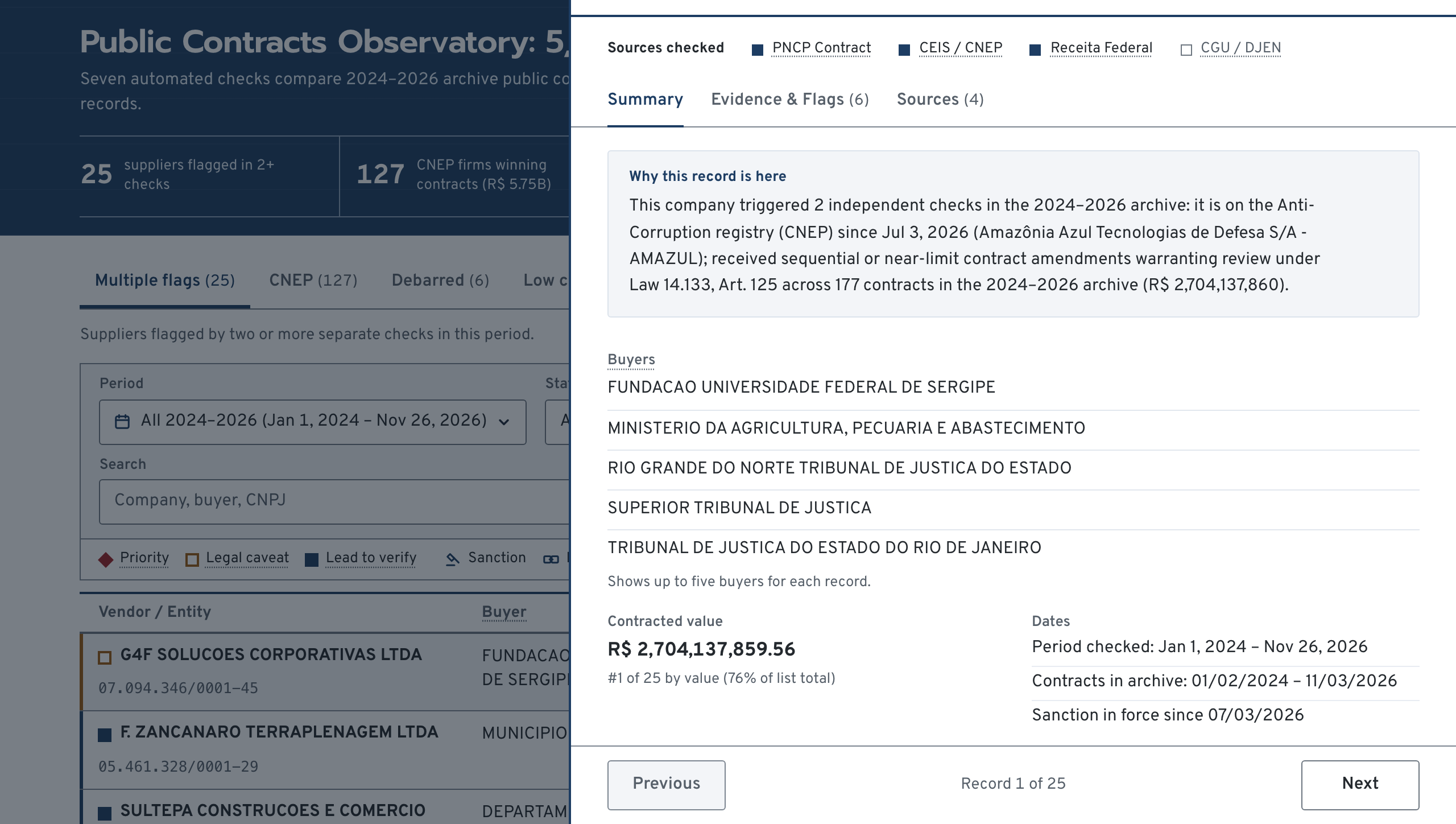
An interactive registry of companies flagged by one or more risk checks, filterable by state, level of government, and signal type. Click a row and the record opens with the evidence.

Every record cites:

  • The PNCP number of each contract
  • The ownership link from the QSA, with no personal names
  • The sanction entry in CEIS or CNEP
Open the Observatory
Screenshot of the Public Contracts Observatory with the list of flagged suppliers on the left and one record open on the right, showing sources checked, buyers, and contracted value
The Observatory: suppliers flagged by multiple checks, with one evidence record open.

Macro Analytics

For anyone who wants the national picture, not a single case.

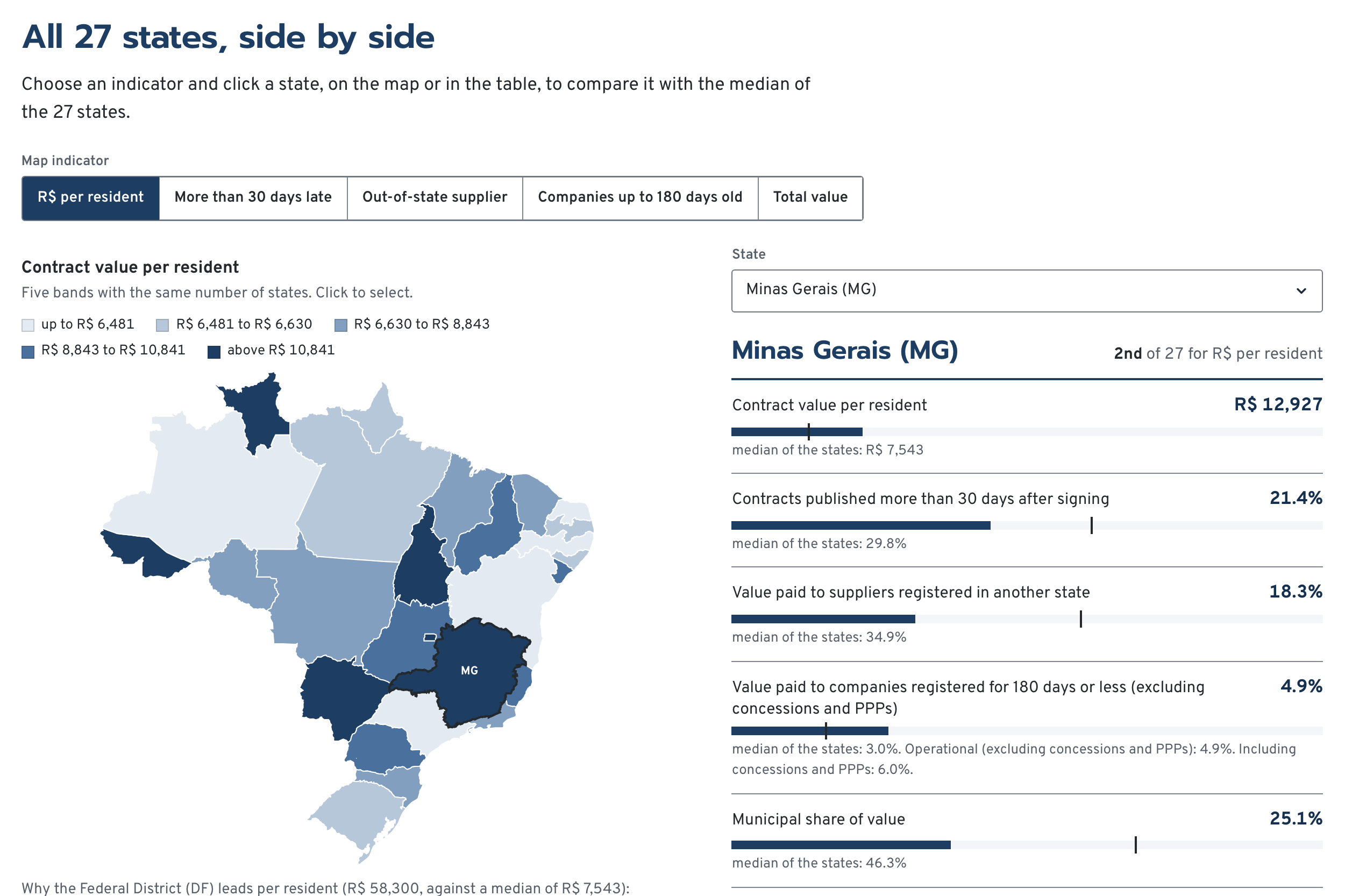
A health scorecard for public procurement, with all 27 states side by side. Pick an indicator, click a state, and compare it with the median of the states.

The scorecard measures:

  • Compliance with publication deadlines
  • Concentration by corporate group
  • Audited samples of contract amendments and tenders
Explore Macro Analytics
Screenshot of Macro Analytics with a map of Brazil shaded by contract value per resident and, beside it, the indicators for Minas Gerais compared with the median of the states
Macro Analytics: contract value per resident in each state, with one state's scorecard.

Open Methodology

The seven checks follow fixed rules, the same for every supplier. The method shows the sources, the rules that set a match aside, and what a lead means, so every result can be reproduced and challenged.

  • Four official sources. No private database, commercial list, or leaked file.

  • Five exclusion rules. They set aside matches with a lawful explanation before any lead is kept.

  • Portal errors quarantined. 1,777 rows with typing errors and R$ 206.1B in repeated accreditation ceilings are removed before any measure.

Read the open method

No personal tax ID and no partner name appears in any dossier

Every kept case names only companies, official contract numbers, sanction entries, and court case numbers. We check public company ownership records to find related businesses, then leave every personal detail out of what we publish.

What a dossier holds, and what it never holds

Included in dossiers

  • Company name and CNPJ (company tax ID)
  • Contracts published on PNCP
  • Sanction entry in CEIS or CNEP
  • Court gazette check from DJEN

Never published

  • Names of individual partners
  • CPF personal tax IDs
  • Home addresses
  • Personal phone numbers
Read the privacy notice
White modernist colonnade of Brazil's Supremo Tribunal Federal behind the public plaza in Brasília
Supremo Tribunal Federal, Brasília. Public-domain photo (CC0).

Legal basis: records the law requires to be public

Lei 12.527/2011
Access to Information Act: guarantees public access to tenders, contracts, and spending.
Lei 14.133/2021
Procurement Act: requires contracts and tender notices to be published on the national portal.
PNCP
The national procurement portal: the official source of every contract we analyze.
LGPD, Art. 7, IX
Legitimate interest in public-procurement oversight on manifestly public data (with §§ 3 and 7). Companies only, by CNPJ. No individual's name or CPF is published.

How to cite: Tidemark (2026). Public Contracts Observatory and Macro Analytics, 2024 to 2026. https://tidemark.institute/en/

What is live today and what comes next

  1. Now, 2026

    Three tools live

    The Observatory, Macro Analytics, and Briefings, covering all 27 states and the 2024-to-2026 archive.

  2. Next

    Larger samples

    Wider audited samples of contract amendments and competitive tenders.

  3. 2027

    State audit courts

    Records from state audit courts (TCEs) alongside the federal registries.

  4. 2027 onward

    API and open rules

    Programmatic access to the data and the published rules behind each check.

Request dossier access or a custom check

Dossiers go to journalists, researchers, and oversight bodies. You can also ask for a specific check by buyer, supplier, or period. Tidemark reviews each request and replies by email.

Every file is a lead for local verification, not a legal accusation or a finding of wrongdoing.

You can also write to us directly.

Data use and rights: Privacy

280 characters left